

From Curiosity to Clarity: Teresa Pugh on Solving the Chemistry Puzzle
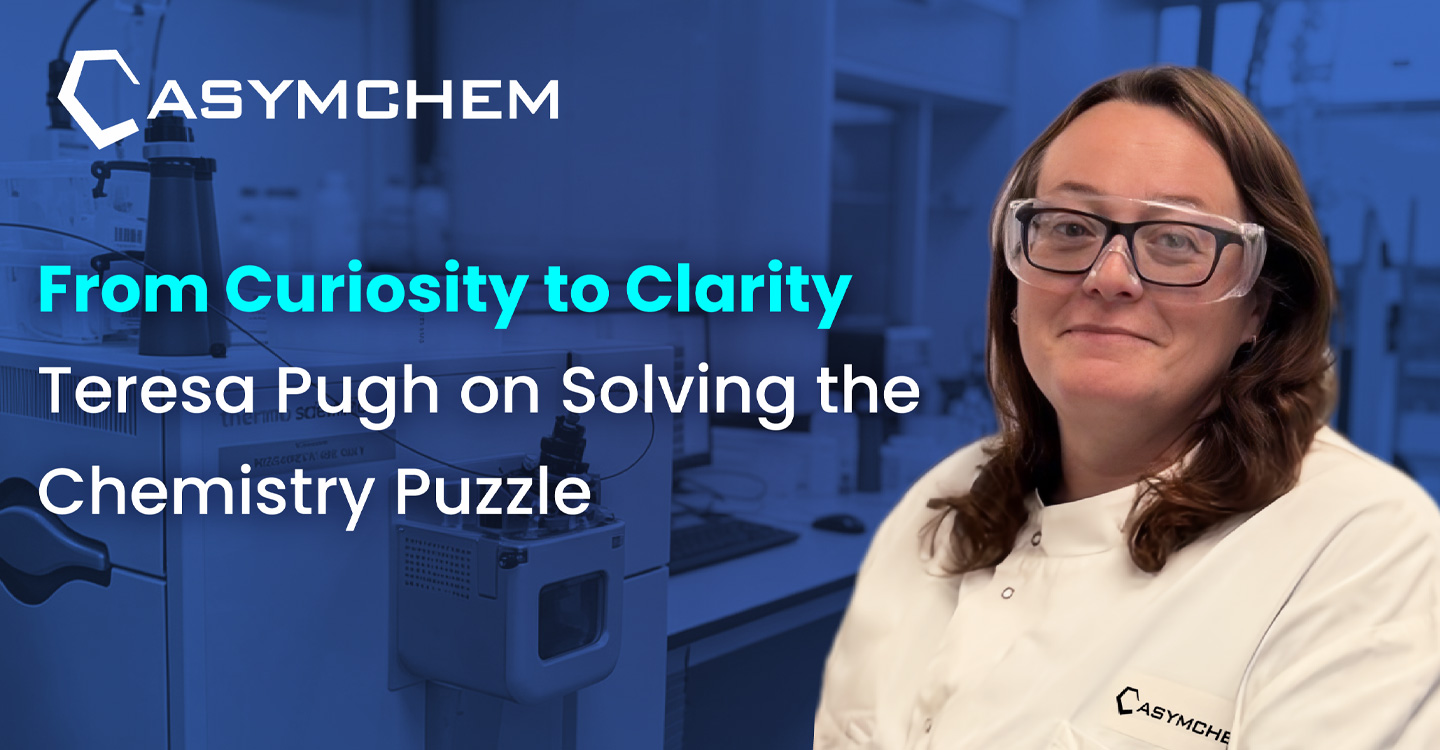
For Teresa Pugh, science has always been about curiosity, problem-solving, and seeing things from different perspectives. Her journey into chemistry began at school, where she found herself equally drawn to two seemingly different subjects: Art and Chemistry. A teacher’s encouragement eventually led her toward a chemistry degree, followed by an MSc in Environmental Chemistry and a PhD in Chemistry at King’s College London.
Today, Teresa is a Structure Elucidation Scientist at Asymchem’s Sandwich site, where she works as part of the Structure Elucidation Group supporting Analytical Research and Development (ARD) and Chemical Research and Development (CRD). Her work combines analytical science, chemical knowledge, and creative problem-solving to uncover the structures behind unknown compounds, impurities, and reaction products.
From Art to Chemistry: Learning to See Molecules in Three Dimensions
Teresa’s early interest in Art may seem far removed from her work in analytical chemistry, but she sees a clear connection between the two.
“I’m quite good at visual and spacial puzzles, where you move things around in your mind,” she explains. That ability to visualize molecules in three dimensions has become a useful part of how she approaches chemistry, helping her think about how molecules might be structured and how different groups fit together.
For Teresa, this illustrates that scientific problem-solving does not always happen through equations or instruments alone. Sometimes, it starts with the ability to picture a problem differently.
From Data to Understanding: Solving the Chemical Puzzle
At the heart of Teresa’s role is structure elucidation—the process of using analytical data to determine what has actually happened chemically.
Her work involves techniques including mass spectrometry, NMR, and chromatography, which can help identify unknown impurities, confirm product structures, investigate unexpected by-products, and understand whether a reaction has produced the intended compound. The information generated can also support process optimization, troubleshooting, and the comparison of different batches.
For Teresa, however, structure elucidation is more than simply operating sophisticated instruments. A strong foundation in synthetic organic chemistry is essential.
“You understand how molecules behave, how molecules react and how molecules are put together,” she explains. This knowledge provides the foundation for interpreting how molecules fragment during mass spectrometry and understanding how structural features can influence their behavior.
This combination of analytical expertise and chemical understanding allows Teresa to turn complex datasets into meaningful scientific conclusions.
From Challenge to Clarity: The Reward of Solving an Unknown
Mass spectrometry is Teresa’s particular area of expertise, and one of the aspects she finds most engaging is understanding how molecules behave under different mass spectrometric conditions.
Small molecules can fragment in very different ways depending on their functional groups, size, shape, and overall structure. Understanding these patterns helps Teresa determine the most appropriate ionization approach and acquisition parameters when investigating challenging impurities.
The most rewarding moment comes when the pieces finally begin to fit together: experimental data, chemical reasoning, and structural evidence converge to explain what has actually been formed.
It is a process that requires patience and attention to detail—but also curiosity. Every difficult impurity presents another chemical puzzle to solve.
From Guidance to Confidence: Helping the Next Generation
Teresa’s passion for science extends beyond her own work. Through STEM outreach and undergraduate supervision, she has had the opportunity to help students discover that science is not something distant or inaccessible, but something connected to the world around them. Her outreach activities have included local primary school science days and the Discovery Park Science Jamboree.
For Teresa, one of the most rewarding parts of mentoring is watching students evolve.
At the beginning of a project, students can feel overwhelmed by unfamiliar terminology and complex scientific concepts. Over time, as they read, experiment, and gain experience, Teresa sees them become increasingly confident and independent. Eventually, they begin leading their own projects, making suggestions, and even challenging her ideas.
And that, she says, is something she particularly enjoys.
“I love it when they challenge me—it brings out my best.”
Some of her former students have gone on to pursue scientific careers, including roles in mass spectrometry research. For Teresa, knowing that she has played even a small part in helping them progress is deeply rewarding.
From Complexity to Curiosity
Looking across Teresa’s career, a common thread emerges: the ability to make sense of complexity.
Whether she is interpreting mass spectrometry data, visualizing a molecule in three dimensions, investigating an unknown impurity, or helping a student understand a challenging research project, Teresa approaches science with curiosity and a willingness to look at problems from different perspectives.
Her journey also demonstrates that a career in science is not defined by a single skill or discipline. Creativity can influence scientific thinking. Experience can deepen technical understanding. And sharing that knowledge can help inspire the scientists who come next.
For Teresa, perhaps the most important part is staying curious—because behind every complex dataset, unfamiliar molecule, or challenging problem, there is another puzzle waiting to be solved.